Profile Perfect
- 4.4
- Rating
- 1.00M
- Installs
- Free
- Price

 Analysis by App-foxy
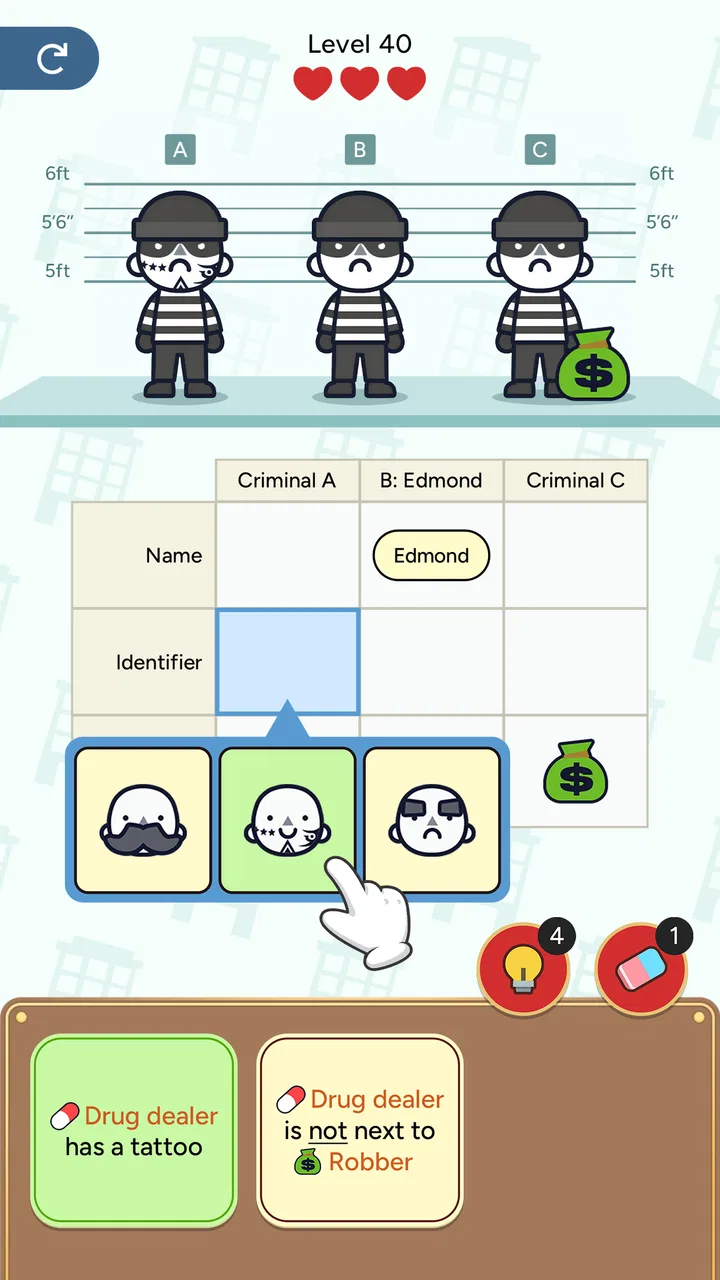
I went into Profile Perfect expecting a light puzzle game and found a more focused kind of brain exercise. Its central idea is simple: you work through logic-grid challenges while looking for clues that help complete a profile. That combination gives each puzzle a small investigative feeling without turning it into a story-heavy adventure. I found myself paying attention not just to individual hints, but to how each piece of information narrowed the remaining possibilities.
That makes this a good fit for short sessions when I want something more thoughtful than a casual matching game. It is free to start, rated for Everyone, and developed by Lion Studios Plus. The game is listed in the puzzle category, and its current version is 0.8.1. The store page shows a 4.6 average from around 3 thousand ratings, with over 100 thousand installs, so there is already a meaningful audience trying this particular take on logic puzzles.
How the profile-based puzzles feel to play
The appeal comes from turning a familiar logic-grid format into a clue-hunting task. Instead of treating every puzzle as a completely abstract table, I approached each one as a small deduction problem: identify what a clue really tells me, connect it to the other details, and eliminate options until one arrangement remains. That framing makes the process easier to follow than a bare grid can be, especially if you enjoy puzzles that give your reasoning a clear purpose.
You May Also Like

 Blood Strike: 2.5 Anniversary
Blood Strike’s Loadouts Turn Every Drop Into a Tactical Gamble
A close look at Blood Strike’s custom loadouts: how fast access to signature weapons reshapes its battle royale rhythm, rewards preparation, and narrows the gap between fights.

 Pandora - Music & Podcasts
Pandora’s Music Is Easy to Start, but Harder to Recover
Pandora’s strength is its low-effort path from a seed to a station. Its weak spot is how much confidence it asks you to place in connection, setup, and quiet recovery.

 8 Ball Pool
 Is Built on Rivalries, Rematches, and Routine
A close look at the rivalries, rematches, shared routines, and unanswered safety questions that turn a quick pool match into a persistent mobile community.

 Samsung Music
’s Quiet Strength Is Playing What You Already Own
Its reach comes less from spectacle than from dependable access to a personal library. That simplicity is both the app’s strongest retention engine and its ceiling.

 AccuWeather: Weather Radar
AccuWeather Review: A Quick, Clear Forecast for Everyday Decisions
For everyday plans, the best forecast is the one you can understand quickly. AccuWeather makes rain timing, radar, and local conditions easy to act on, with a few trade-offs.

 Hill Climb Racing
Why Hill Climb Racing Still Turns Crashes Into One More Run
A tiny car, a bumpy hill and one more upgrade: Hill Climb Racing keeps resurfacing because its simple chaos makes every near-miss feel personal.
More From Our News Desk



My most useful habit was to slow down before placing an answer. A clue that appears to identify one person or detail may actually only rule out a pair of possibilities. I found better results by marking the relationships I was certain about first, then using those confirmed links to test the less obvious clues. This prevents the common mistake of treating a guess as a fact and building the rest of the puzzle around it.
The game works best when I give each clue a role. Some clues establish a direct connection, while others become valuable only after another deduction has been made. That layered structure is what separates a satisfying logic puzzle from a sequence of random taps. It also means the game rewards patience more than speed. If you rush through the first few clues, the later part can feel confusing even when the answer is still logically reachable.
For a realistic everyday use case, I can see myself opening it during a short break, on public transport, or at the end of the day when I want to stay mentally active without committing to a long game. A single puzzle can be treated as a complete session rather than something that demands an uninterrupted evening. I also like that this format lets me stop after reaching a natural deduction point and return later with the problem still understandable.
That said, this is not the right choice for someone looking for immediate action or constant visual stimulation. The pleasure is in narrowing possibilities, not in rapid reactions. Players who prefer word searches, match-three rounds, or arcade puzzles may find the pace deliberate. I would also skip it if I wanted a game that could be played almost entirely on instinct, because the best results here come from reading carefully and keeping track of relationships.
Small solving habits that make a big difference
I found three practical habits especially helpful. First, I treated negative information as useful rather than secondary. Knowing that one detail cannot belong to a particular profile can be just as important as a direct match, because it removes an option that might otherwise distract me later.
Second, I avoided filling every space immediately. Leaving uncertain relationships open made it easier to see which clue could resolve them naturally. Completing a grid too aggressively creates false confidence, while a partially solved grid often exposes the next logical move more clearly.
Third, I revisited earlier clues after making a firm deduction. A clue that seemed vague at the beginning could become decisive once one profile or category had been reduced to a single possibility. This is a useful workflow for anyone who normally gets stuck because they assume every clue has the same value from the start.
These habits are not complicated, but they change the experience. The game becomes less about tapping until something works and more about managing information. That is the strongest reason I would recommend it to people who enjoy traditional logic puzzles but want a more approachable presentation.
Progress, pressure, and the cost of continuing
Because the game is free, the first question many players will have is whether spending is necessary to enjoy it. The purchase range shown for the game runs from $1.99 to $99.99 per item. That is important context, but it does not by itself tell me how often purchases appear, what they unlock, or whether they affect puzzle access. I would therefore approach the game as free to try, while checking each purchase prompt carefully before confirming anything.
I did not find it useful to judge the game by the existence of optional spending alone. The more relevant question is whether the puzzle-solving loop remains comfortable without paying. For a logic game, pressure can come from several places: limited attempts, blocked progress, hints, or interruptions. Those systems can change the feeling of deduction, especially if a player starts making guesses simply to avoid waiting or spending.
My advice is to keep a clear distinction between a genuine deduction and a move made under pressure. If a hint or purchase prompt appears when I am uncertain, I would rather pause and review the clues than pay to bypass the part that makes the puzzle meaningful. That approach also helps reveal whether the game suits me before I spend anything. A free starting point is valuable precisely because it lets players test the rhythm and difficulty first.
The purchase range also means families should be mindful when the game is used on a shared device. The Everyone age rating makes the content broadly accessible, but age suitability and spending control are separate issues. I would recommend reviewing device purchase settings before handing it to a child, particularly because the listed upper end of individual purchases is substantial compared with the price of many small mobile games.
For adults, the practical trade-off is straightforward. Paying may be reasonable if it removes a specific frustration and the game has already proved enjoyable, but I would not buy simply because a puzzle feels difficult. Difficulty is part of the intended activity here. A purchase that bypasses deduction could reduce the very satisfaction that makes the game worth opening.
Does the game feel fair against other puzzle options?
Compared with a standard logic-grid app, Profile Perfect has a more guided identity. The profile theme gives clues a recognizable context, which can make the puzzle feel less like a worksheet. I found that helpful when I wanted a little narrative flavor without reading long passages or managing a complex plot.
Compared with a match-three or word game, it is slower but more deliberate. Those alternatives usually provide faster feedback and a more obvious sense of momentum. Here, progress is measured by understanding. A player who enjoys spotting patterns and testing conclusions may find that rewarding, while someone who wants a quick win after every move may prefer a different puzzle style.
Against purely competitive puzzle games, its apparent strength is that the challenge is personal rather than dependent on another player’s performance. I can work through a clue at my own pace and focus on accuracy. However, that also means it may feel less exciting to players who need leaderboards, head-to-head rounds, or visible social comparison to stay motivated.
Fairness matters most when a game mixes reasoning with monetization. I would consider the experience fair if optional spending does not turn basic progress into a paywall or make careful solving feel pointless. The available purchase information establishes that paid items exist across a wide range, but it does not establish how they interact with progression. I would keep that distinction in mind rather than assuming either the best or worst case.
In practical terms, I would recommend trying several puzzles before deciding whether the balance feels right. Notice whether you can solve through patience, whether prompts interrupt concentration, and whether the game respects a player who chooses not to buy. Those observations are more useful than the presence of a purchase button by itself.
What I would want to know before installing
One likely question is whether the game is suitable for a quick session. Yes, the logic-grid structure naturally supports short play periods, although the exact length of a puzzle can vary with reading speed and difficulty. I would not expect every challenge to fit into a few spare minutes, but I can comfortably use it as a break-time game because the solving process has clear stopping points.
Another question is whether it requires advanced puzzle experience. I do not think a specialist background is necessary. The useful skills are basic reading, comparison, elimination, and patience. Experienced logic players may move faster, but beginners can improve by recording only firm conclusions and returning to unclear clues later.
Some readers will also wonder whether it is appropriate for children. Its Everyone content rating makes it broadly suitable from a content perspective. Still, younger players may need help understanding indirect clues, and adults should separately manage purchases on shared devices. I would treat it as a possible family-friendly puzzle, not as an entirely hands-off activity for every age.
Device compatibility is another practical point. The game supports Android 7.0 and later, which covers many older Android devices while still leaving very old hardware outside its supported range. Before installing, I would check the operating-system version rather than assuming every Android phone can run it.
Finally, players who care about spending should know the basic boundary up front: the game is free, but in-app purchases are listed from $1.99 to $99.99 per item. I would start without buying, see how the puzzle flow feels, and only consider spending after understanding what a particular item does and whether it improves the experience I actually want.
My trust verdict after weighing the trade-offs
My overall impression is positive, but specific. Profile Perfect is strongest as a calm, clue-driven puzzle game for people who enjoy deduction and want a profile theme to give their logic work some context. I like the way it encourages players to connect information rather than rely on reflexes, and I think the format is well suited to short breaks, quiet evenings, and anyone trying to replace passive scrolling with a small mental challenge.
I would not recommend it to players who need fast action, deep storytelling, or a competitive multiplayer hook. I would also be cautious about spending until I had experienced enough of the free game to understand how optional purchases fit into progress. The listed prices make that caution sensible, especially for families using shared devices.
The game’s 4.6 average and roughly 3 thousand ratings suggest that many players are responding well to its approach, while the install count of more than 100 thousand shows that it has reached a healthy early audience. Those figures are useful signals, but they do not replace personal testing. Logic games can feel rewarding to one person and overly slow to another, even when both appreciate the same theme.
Released on August 15, 2025, and currently at version 0.8.1, it is still a relatively new entry for anyone discovering it now. I would give it a fair trial without rushing through clues or purchases. The best way to judge its value is to see whether the deductions themselves feel satisfying before anything paid enters the picture.
For me, that standard is met often enough to make it worth recommending. I would install it when I wanted a focused puzzle rather than a noisy distraction, keep my deductions deliberate, and treat every purchase prompt as optional until proven useful. If that sounds like the kind of challenge you enjoy, Profile Perfect is an appealing free puzzle to try, with enough structure to reward careful thinking and enough uncertainty around spending to justify a measured approach.
FAQs for Profile Perfect
01What is Profile Perfect and what does it offer?
Profile Perfect is a mobile application designed to enhance and personalize your social media profiles. It offers tools for creating custom profile pictures, banners, and posts. Users can choose from a variety of templates, filters, and editing tools to make their profiles stand out on platforms like Instagram, Facebook, and Twitter.
02Is Profile Perfect free to use, or are there in-app purchases?
Profile Perfect is free to download and offers basic tools at no cost. However, the app includes in-app purchases for premium features, such as exclusive templates and advanced editing tools. Users can subscribe to a monthly or annual plan to unlock these additional features, enhancing their customization options.
03What platforms is Profile Perfect available on?
Profile Perfect is available for both Android and iOS devices. Users can download the app from the Google Play Store or the Apple App Store. The app is regularly updated to ensure compatibility with the latest mobile operating systems and to provide new features and improvements.
04How user-friendly is Profile Perfect for beginners?
Profile Perfect is designed with a user-friendly interface, making it accessible for beginners. The app includes a variety of tutorials and tips to help users navigate the features and tools effectively. Even those with little to no experience in photo editing will find it easy to create professional-looking profile enhancements.
05Does Profile Perfect require an internet connection to function?
While Profile Perfect does not require a constant internet connection for basic editing tasks, some features, such as downloading new templates or sharing edited content directly to social media, do require connectivity. It's best used with an internet connection to take full advantage of all its capabilities.
Pros
- Intuitive user interface for easy navigation.
- Offers a wide range of customization options.
- Fast performance with minimal lagging.
- Supports multiple profile themes and layouts.
- Regular updates with new features.
Cons
- Some features require in-app purchases.
- Limited support for older devices.
- Occasional ads can be intrusive.
- Initial setup might be time-consuming.
- Requires a stable internet connection.

Profile Perfect
Gallery